.avif)

If you have been following my work, you know that I am dedicated to helping women thrive, not just survive. From Rwanda to New York City, I have seen what happens when a woman is given the right support at the right moment. More often than not, that support is a microgrant that removes a critical barrier to success.
It might be a bus fare. A pair of work boots. Childcare for a job interview. A one-time certification fee. These things can be gamechangers for a person's life.
In the world of philanthropy, there are transformative gifts, like naming buildings, funding capital campaigns, and launching global initiatives. These contributions are essential. But I have discovered something equally powerful: proximity, precision, and the belief that even small investments can unlock major progress.
Take our work with the New Jersey Reentry Corporation. Through a microgrant program we helped build, women returning from incarceration were given immediate access to what they needed to reenter society successfully. The assistance covered healthcare, housing, transportation, professional clothing, and other essential items. Some of these women had been incarcerated because they could not afford court fees. Others had no childcare support to attend mandatory hearings. Many were on the verge of slipping through the cracks.
Our microgrants helped stop that free fall.
The results speak for themselves. Zero participants who received our microgrants returned to prison. That is compared to a national recidivism rate that hovers over 50 percent.
This is not just a charitable success story. This is a replicable model. In fact, it has been so successful that we are now expanding it to a program for men as they reenter society.
We saw similar outcomes at Brooklyn Workforce Innovations, where our “Tools of the Trade” fund helped trainees over 900 times to cover critical last-mile costs. These were things like safety gear, certification fees, and subway cards. When these barriers were removed, people succeeded. In 2024, 90 percent of participants graduated, and 80 percent were placed in stable jobs. Many doubled or even tripled their incomes in a matter of months.
At Grace Institute, a program we proudly support, women are trained for high-demand roles in healthcare and technology. But they also receive wraparound support, confidence-building, mental health resources, and peer mentorship. The results? Graduates saw an average wage increase of more than $17 an hour. Collectively, they generated over $2 million in new annual income.
This has been so successful that Columbia Presbyterian Hospital has confidently hired many of the graduates, as well as JPMorgan Chase and Bank of America.
These investments may look small on a spreadsheet. But when measured in economic impact, the return is astonishing. It is the math of proximity and trust.
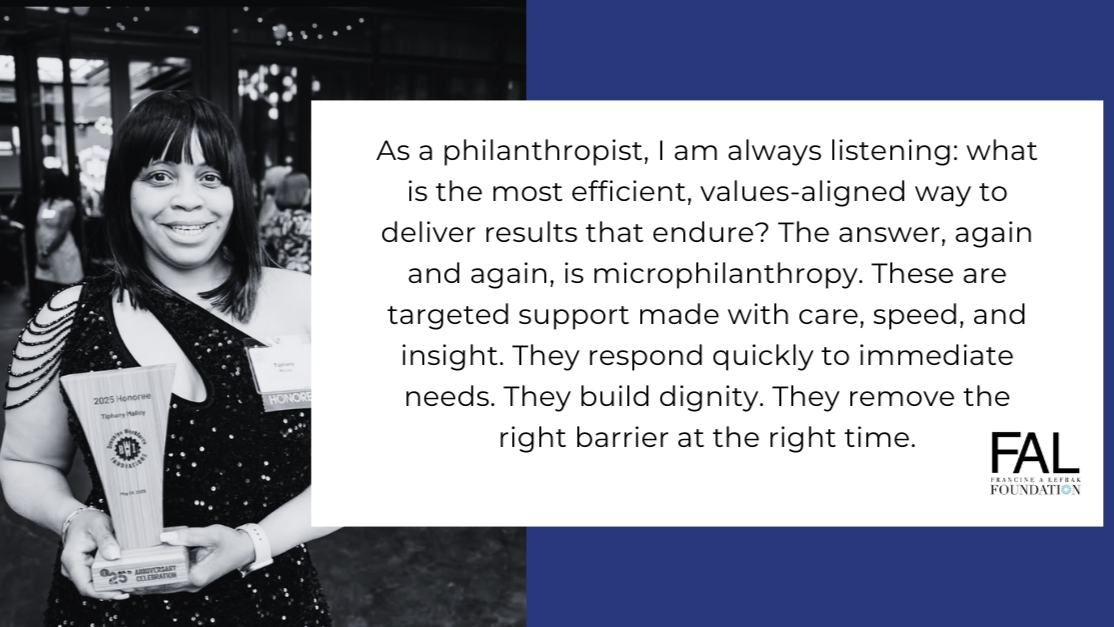
As a philanthropist, I am always listening: what is the most efficient, values-aligned way to deliver results that endure? The answer, again and again, is microphilanthropy. These are targeted investments made with care, speed, and insight. They respond quickly to immediate needs. They build dignity. They remove the right barrier at the right time.
At a moment when the philanthropic sector is reflecting deeply on its role in equity, justice, and democracy, I hope we also remember something simple. Big change often begins with a small act of generosity. And the closer we are to the communities we serve, the more precise and effective that generosity becomes.
Let us reimagine what power looks like in giving. Let us remove roadblocks. Let us pay attention to the shoes someone needs, the bus fare they cannot afford, and the clean clothes required for a job interview.
Small gifts change lives.
We just have to be close enough to notice and listen.
.svg)